click to hide/show image |
Tarot |
|
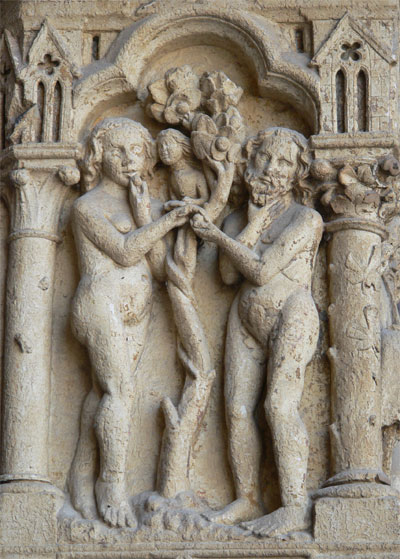
partaking of the tree of knowledge
∞∞∞
'the woof and warp of all thought and all research is symbols, and the life of thought and science is the life inherent in symbols'
…
C. S. Peirce "The Ethics of Terminology", CP 2.220
. ∴ .
Tarot as spiritual tool
To those familiar with Tarot, it may seem a little odd that I used the stone carving of Adam and Eve at the Tree of Knowledge of Good and Evil as my entry point.
I was reminded of the adage that a little knowledge is dangerous. In some ways, Tarot can be like that, in that one can presume to know far more than is really the case: whether this be about oneself; about others; or about tarot itself. And with this 'knowledge' further presume to be able to cause (or seek to effect) a change leading to a specific result that may, inadvertently, instead lead in other directions.
If there is something about Tarot that is of high merit and praise, it is that is allows ever deeper reflections into the realm of symbolism. A symbol, and especially a sacred symbol, is one that always points beyond itself, and yet also binds itself to that to which it points. It therefore has, to be sure, a literal meaning that is as real as its allegorical, its pure symbolic, and its spiritual referents.
The five 'suits' of Tarot
I'm increasingly unsure how to best describe the structure of a deck. To characterise it without caricature, I shall here describe it (alphabetically) as a deck having five suits: the suit of 22 iconic Atouts or trump imagery; the suit of Batons; of Cups; of Deniers (or coins); and of Epées (or swords), these last four suits each containing ten pips and four court cards.
The twenty-two trumps
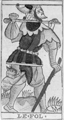
Here I shall simply list them in the classical or 'Marseille'-style order, calling to mind that early decks had neither number nor title. In the Marseille-style, the thirteenth card often carries no title (though some, such as the early Noblet deck, do!), and the Fou or Mat carries no number (though placed by some, including myself, as the twenty-second card). In the list which ensues, I have retained (in red) French titles when its common translation misleads.
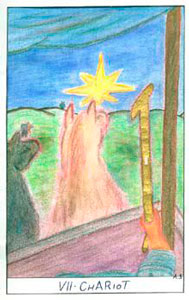
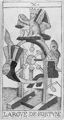
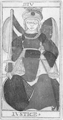
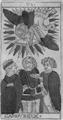
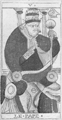
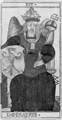
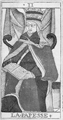
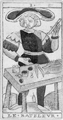
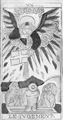
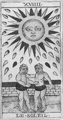
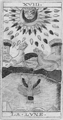
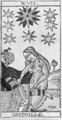
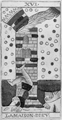
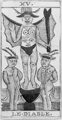
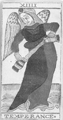
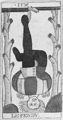
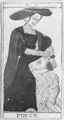
I–Bateleur; II–Popess; III–Empress; IIII–Emperor; V–Pope; VI-L'Amoureux; VII–Chariot; VIII–Justice; VIIII–Hermit; X-Wheel of Fortune; XI–La Force; XII–Le Pendu; XIII–Death; XIIII–Temperance; XV–Devil; XVI–Maison Dieu; XVII–Star; XVIII–Moon; XVIIII–Sun; XX–Judgement; XXI–the World; Fou
It should also be pointed out that various attempts have been made to re-arrange their classical ordering. Personally, I find that the classical order has an inner vibrancy and quality that remains unmatched.
Ordering of trumps
In the above presentation, the twenty-two trumps are presented (nearly) sequentially – in this case from right-to-left. If we briefly look at the sequence as presented, let us take note of a few features.
Firstly, there is a progression from I-VIIII, then the X visually asks us to 'turn around' and repeat this series as the 'other side' of the first, from XI-XVIIII. In that sense, XI becomes the inner quality of I, XII of II, etc..
At the conclusion of this, XX calls us back out again to the light of day, to emerge as an accomplished human being in its highest form (XXI), often presenting itself to the world as but a Fool.
Petroglyphs and Tarot
A key original intent for this site around two decades ago was to illustrate the relationship between petroglyphs from especially late mediæval religious houses and trump imagery. Much of this work has also been included in my book (Reading the Marseille Tarot) - though numerous images still await resumption. I'm not sure when I'll resume this. To get an idea as to what I had started, Cf. XVI - Maison Dieu.
Videos - tarot with Jean-Michel David or references to Reading the Marseille Tarot
> Tarot videos
|